From Research to Reality: The Story of Brim Analytics

February 5, 2026
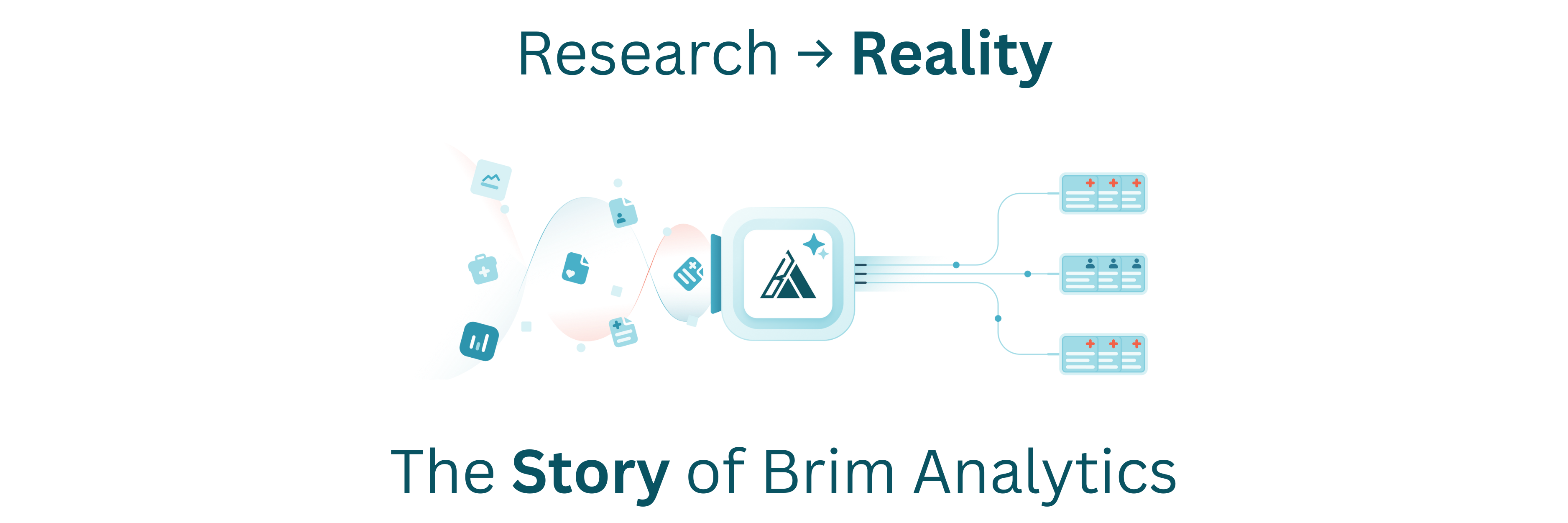
In clinical research and healthcare operations, there’s a problem almost everyone recognizes, and almost everyone underestimates.
Critical information lives in unstructured clinical notes. Finding it means manual chart review, spreadsheet tracking, custom scripts, and long hours from highly trained experts. Whether the goal is enrolling patients in clinical trials, maintaining a registry, or understanding outcomes across a population, chart abstraction remains one of the biggest bottlenecks in turning data into insight.
Brim Analytics exists because this problem refused to go away.
A Problem Seen Up Close
Long before Brim was a product, it was a recurring frustration observed firsthand by researchers working at the intersection of medicine, data, and technology. As a faculty member focused on clinical informatics and natural language processing, Daniel Fabbri repeatedly saw research teams reinvent the same fragile tools to extract meaning from clinical notes.
Each project started from scratch. Each workflow was brittle. And each solution worked just well enough: until the data changed, the research question evolved, or the study scaled.
The deeper insight wasn’t just that chart abstraction was hard. It was that approaching it with custom code, one-off logic and lots of human hours was fundamentally misaligned with how real-world research and healthcare teams work.
Born at Vanderbilt
Those early insights took shape at Vanderbilt University, where years of applied research explored how AI and NLP could support clinical data abstraction responsibly.
The focus was on helping domain experts like clinicians, researchers, and abstractors work faster and with greater confidence, without requiring them to become machine learning engineers. The first idea was to build a system to crowd-source abstraction problems.
This work laid the foundation for what would eventually become Brim: a system designed to handle messy, real-world clinical data while keeping humans firmly in the loop.
The DAGCAP Project and ARPA-H Validation
That foundation scaled dramatically with the launch of the Democratized AI-Guided Chart Abstraction Platform project, or DAGCAP, supported by funding from ARPA-H.
ARPA-H backing was more than financial support; it was validation that this problem mattered at a national level. The DAGCAP project pushed the work beyond prototypes and into environments where scale, rigor, and reliability were non-negotiable.
Through DAGCAP, the team learned critical lessons that have shaped Brim:
- Large language models alone aren’t enough for high-stakes healthcare use cases
- Transparency and validation are essential, not optional
- Flexibility and usability are essential for abstraction tools.
Most importantly, the work showed that AI-assisted chart abstraction could support multi-site clinical research without sacrificing trust or quality.
From Research Project to Real Product
As DAGCAP matured, a clear realization emerged: this technology couldn’t stay confined to academic research projects.
Research teams, registries, and healthcare operations groups were all facing the same challenges, often with fewer resources and tighter timelines. Grant-funded tools weren’t designed to be maintained, extended, or supported long term. And most solutions built by AI-native companies weren’t built for the nuance of clinical data.
Spinning Brim out of Vanderbilt was a deliberate choice to make the work durable.
Becoming a company meant investing in usability, security, and support. It meant designing for real-world workflows, not idealized datasets. And it meant building software that research and healthcare teams could rely on year after year.
The Philosophy: Don’t DIY AI
Many of Brim’s core ideas are captured in our earlier post about why we’re aiming for The Next Cure, Faster. At its heart is a simple belief: researchers and healthcare teams shouldn’t have to DIY AI to do meaningful work.
DIY approaches tend to break down quickly. They’re hard to explain, difficult to validate, and nearly impossible to adapt as research questions evolve. Brim was designed around a different philosophy:
- Modularity instead of monoliths
- Explainability instead of black boxes
- Human expertise amplified by AI, not replaced by it.
This approach allows teams to iterate, review, and improve results over time without locking themselves into brittle pipelines or opaque systems.
What Brim Is Today
Today, Brim is a platform for AI-assisted chart abstraction built specifically for clinical research and healthcare operations.
Teams use Brim to:
- Abstract data from unstructured clinical notes
- Combine structured and unstructured data in a single workflow
- Support clinical trials, registries, and operational use cases
- Validate and review results with human oversight
Brim’s roots in academic research, at Vanderbilt, and through ARPA-H–funded work continue to shape everything we build. Brim is used by academic researchers, healthcare data leaders, and operations teams who need flexibility, transparency, and trust in addition to abstraction speed.
Rather than forcing a single workflow, Brim adapts to how teams actually work, whether they’re running a registry, preparing for a clinical trial, or exploring new research questions.
See What Brim Can Do For You
Teams are using Brim to improve the speed and accuracy of chart abstraction across their workflows. Recent case studies include:
- Case Study: Reducing Surgical Rescheduling from Weeks of Manual Review to Hours with Brim
- Case Study: Discovering a Rare Disease Cohort in Minutes with Brim
- Case Study: Empowering Domain Experts to Make Clinical Judgment Explicit
Want to learn more about one of these cases and how Brim can apply to your use case? Book a demo today.